Plural nouns are part of daily life. Children use them when they talk about toys, food, animals, and people. They use them when counting and when sharing ideas. Learning plural nouns helps kids speak with confidence. It also helps them write sentences that make sense. This lesson keeps things simple and easy to follow so learning does not feel hard or confusing.
A noun is a word that names something. It can name a person, a place, a thing, or an animal. Words like teacher, school, pencil, and cat are all nouns. Nouns are everywhere in spoken and written language. Children hear nouns in stories, songs, and daily conversations. Understanding nouns is the first step toward building strong language skills.
When we talk about only one noun, we use a singular noun. A singular noun means one. For example, one apple, one pen, or one child are all singular nouns. Using singular nouns helps children describe a single object clearly. It also helps them understand basic number words like one and first. Singular nouns are usually easier for young learners to understand.
When we talk about more than one noun, we use a plural noun. Plural nouns show that there is more than one person, place, thing, or animal. For example, two apples, three pens, or many children are plural nouns. Plural nouns help children talk about groups and quantities. They are important for both speaking and writing.
🗂️What is a Plural Noun?
A noun is a word for a person, place, thing, or animal.
When we talk about one thing, we use a singular noun.
👉 Example: one apple 🍎
When we talk about two or more things, we use a plural noun.
👉 Example: two apples 🍎🍎
🗂️How to Make Plural Nouns
Here are some simple rules to turn singular nouns into plural nouns:
1. Add -s
Most nouns just need -s to become plural.
- apple → apples
- pen → pens
- orange → oranges
2. Add -es
If a word ends with s, x, ch, sh, or z, we add -es.
- box → boxes
- bus → buses
3. Change the Word
Some words are a little tricky — they completely change in their plural form!
- tooth → teeth
- goose → geese
- mouse → mice
4. Stay the Same
Some nouns don’t change at all.
- fish → fish
- sheep → sheep
5. Change -y to -ies
If a word ends with a consonant + y, change the y to -ies.
- baby → babies
- party → parties
6. Change -f or -fe to -ves
If a word ends in f or fe, change it to ves.
- knife → knives
- leaf → leaves
Learning plural nouns supports early grammar development. It helps children understand how words change based on meaning. It also improves reading comprehension because kids can better understand sentences that talk about more than one thing. Plural nouns are used often in books, instructions, and classroom discussions. This makes them an important skill for young learners.
Most plural nouns follow simple rules. These rules help children know how to change a word from singular to plural. The most common rule is adding the letter s at the end of a word. Words like apple become apples, pen becomes pens, and orange becomes oranges. This rule works for many common nouns and is usually the first one children learn.
Some words need more than just the letter s. If a word ends with certain letters, we add es instead. This helps the word sound right when spoken. Words like box become boxes, and bus becomes buses. Children often notice that these words sound smoother with the extra letters. Reading these words out loud helps reinforce the rule.
Not all plural nouns follow the same pattern. Some words change completely when they become plural. These words are called irregular plural nouns. For example, tooth becomes teeth, goose becomes geese, and mouse becomes mice. These words do not follow the usual rules, so children need repeated exposure to remember them. Seeing these words in stories and worksheets helps build familiarity.
Some nouns stay the same in both singular and plural form. The word does not change, even when it means more than one. Words like fish and sheep follow this rule. The sentence tells us if the word means one or many. This can be tricky for young learners at first, but practice helps them understand the difference.
Another rule involves words that end with the letter y. If a noun ends with a consonant and y, the y changes to ies in the plural form. For example, baby becomes babies and party becomes parties. This rule helps children learn spelling patterns while building grammar skills. It also helps them notice how sounds change in words.
Some nouns that end with f or fe change when they become plural. The ending changes to ves. Words like knife become knives, and leaf becomes leaves. Not all words ending in f follow this rule, so it is best to teach these words slowly and with practice. Worksheets help children see these changes clearly.
Practice is an important part of learning plural nouns. Reading rules is helpful, but using them makes learning stick. Writing plural forms helps children slow down and think about the word. It also helps improve handwriting and spelling. Worksheets give children a chance to practice without pressure.
Here’s your printable worksheet to practice plural nouns!
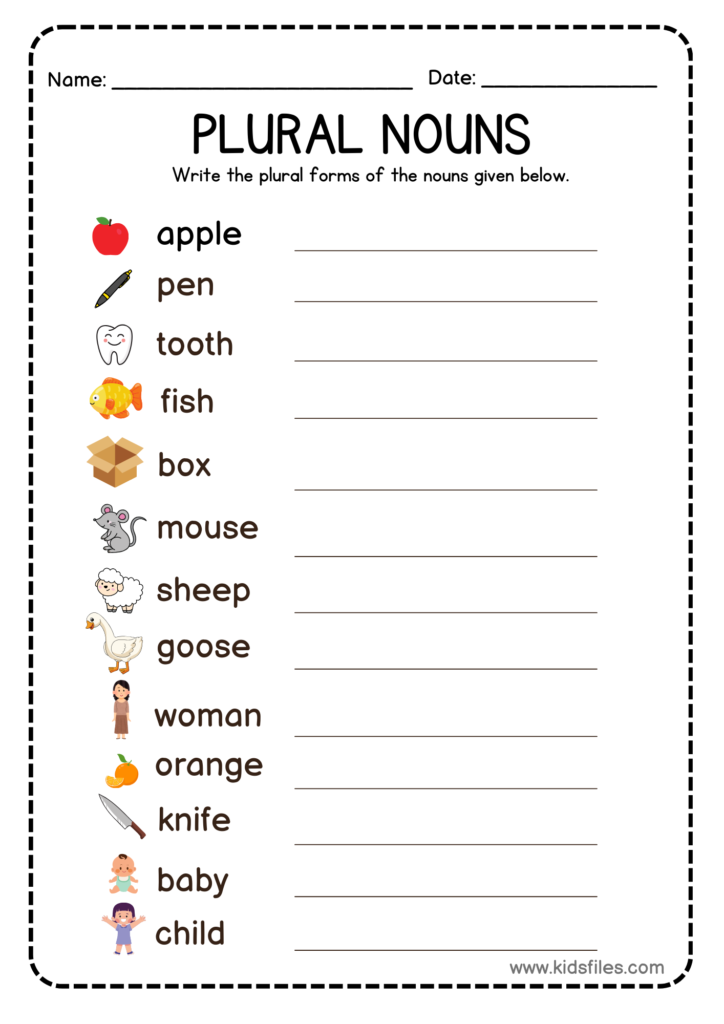
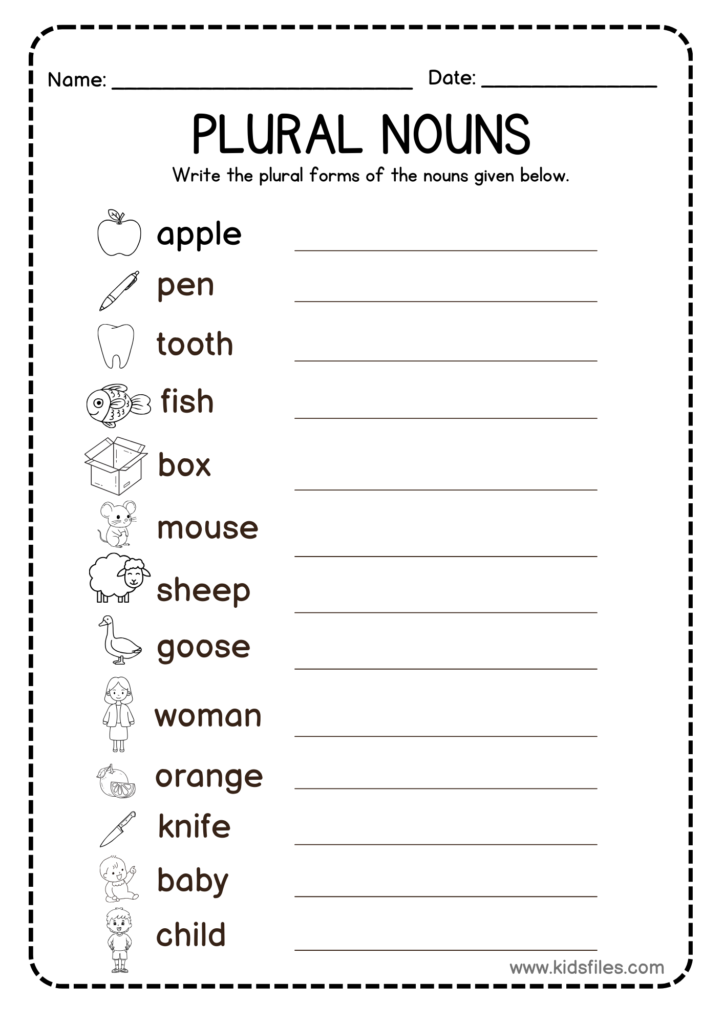
The plural nouns worksheet included in here. Each word comes with a picture to support understanding. Visual cues help children connect words with meaning. The worksheet includes both regular and irregular plural nouns, giving children a balanced practice activity.
Parents can use this worksheet at home as part of a short learning session. Reading the word together and saying the plural form out loud helps reinforce learning. Letting children write the answer on their own builds confidence. Keeping practice time short helps children stay focused and positive.
Teachers can use this worksheet in the classroom for individual work, group activities, or review sessions. It works well as seatwork or homework. Reviewing answers together allows students to hear correct forms and ask questions. The worksheet fits easily into grammar and language lessons.
Mistakes are normal when learning plural nouns. Children may add s to every word or forget irregular forms. Gentle correction and repeated practice help fix these errors over time. Encouragement helps children stay motivated and willing to try again.
Visual learning plays an important role in early education. Pictures help children understand words faster and remember them longer. Clear layouts and simple designs reduce distractions. This helps children focus on learning instead of feeling overwhelmed.
Learning should feel friendly and manageable. Short explanations help children understand ideas without confusion. Simple language makes lessons easier to follow. When children feel comfortable, they are more likely to enjoy learning.
If you enjoyed this lesson, you can explore more learning resources on Kids Files. The site offers printable worksheets, phonics activities, and simple grammar lessons designed for young learners. All materials are ready to print and easy to use at home or in the classroom.
Plural nouns are a key part of early language learning. They help children speak clearly and write meaningful sentences. With clear rules, simple examples, and hands-on practice, children can build this skill with confidence. Thank you for learning with Kids Files. Let’s make learning fun, one file at a time.
Happy Teaching,
>>The Kids Files Team 🗂️💖