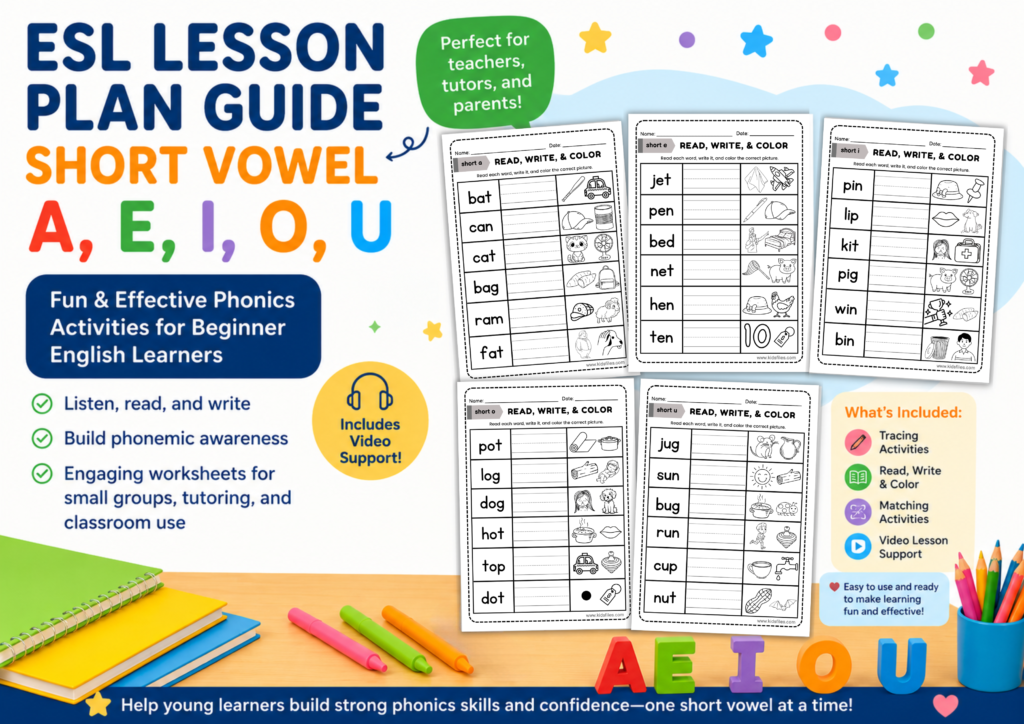
To help teachers, tutors, and parents get started, I created this simple ESL lesson plan for teaching the short /a/ vowel sound. This lesson is designed for beginner English learners and can be easily adapted for small groups, one-on-one tutoring, homeschool lessons, or classroom instruction.
The lesson plan works alongside the free short /a/ worksheets featured on this page. Students can practice recognizing, reading, tracing, matching, and writing short /a/ words through hands-on activities that reinforce learning. The worksheets provide meaningful practice while helping learners stay engaged and focused on one target sound.
For additional support, you can also use the accompanying YouTube video to introduce and review the short /a/ sound. Watching and listening to the sound in context helps learners improve pronunciation, listening skills, and word recognition. Combining visual, auditory, and written practice creates a more effective learning experience for young readers and English language learners.
This lesson follows a simple ESL approach that includes a warm-up, vocabulary presentation, guided practice, independent worksheet activities, and assessment. The goal is to help students hear, identify, pronounce, and read words containing the short /a/ sound with confidence.
Feel free to adjust the lesson based on your students’ age, ability level, and learning needs. Whether you are teaching in a classroom, learning center, or at home, this lesson plan, worksheets, and video can work together to provide a complete and engaging phonics lesson for beginning readers.
Short /a/ Vowel Sound (Beginner Level)
Lesson Overview:
This ESL lesson introduces students to the short /a/ vowel sound through listening, speaking, reading, and worksheet activities. The lesson focuses on simple CVC words that help learners develop early phonics and reading skills.
Objectives:
By the end of the lesson, students will be able to:
- Identify the short /a/ sound.
- Pronounce the short /a/ sound correctly.
- Recognize short /a/ words in pictures and print.
- Read simple CVC words containing the short /a/ sound.
Target Vocabulary words:
- cat
- bat
- bag
- hat
- jam
- ram
Materials Needed:
- Apple flashcard or picture
- Short /a/ word flashcards
- Whiteboard and marker
- Short /a/ worksheets
- Crayons or pencils
Warm-Up (5 Minutes)
Show an apple flashcard to the class.
Ask:
Teacher: “What is this?”
Students: “Apple!”
Explain that the word apple begins with the short /a/ sound.
Model the sound clearly: /a/ /a/ /a/
Have students repeat the sound several times together.
Practice sound repetition:
/a/ /a/ apple
/a/ /a/ ant
/a/ /a/ ax
Encourage students to listen carefully and repeat after you.
Presentation (10 Minutes)
Introduce the target vocabulary using flashcards or pictures.
Show each word and picture one at a time:
cat
bat
bag
hat
Point to each word and model the pronunciation.
Example:
Teacher: “/c/ /a/ /t/ … cat”
Students repeat:
Students: “Cat”
Continue with the remaining words.
Highlight the middle vowel sound in each word.
Ask students:
What sound do you hear in cat?
What sound do you hear in bat?
What sound do you hear in hat?
Guide learners to identify the short /a/ sound.
Guided Practice (10 Minutes)
Practice blending sounds together.
Write words on the board:
c-a-t
b-a-t
h-a-t
b-a-g
Read each sound slowly and blend the sounds together.
Have students repeat as a group and then individually.
Play a simple pointing game.
Say a word and ask students to point to the correct flashcard.
Independent Practice (15 Minutes)
Distribute the short /a/ worksheets.
Students complete activities such as:
Tracing worksheets
Matching words and pictures
Read and color activities
Writing simple short /a/ words
Walk around the classroom and provide support when needed.
Assessment (5 Minutes)
Show five short /a/ word cards.
Ask each student to read the words aloud:
cat
bat
bag
hat
jam
Observe whether students can:
✓ Recognize the short /a/ sound
✓ Pronounce the words correctly
✓ Read simple CVC words independently
Extension Activity
Invite students to draw their favorite short /a/ word and label it. Encourage them to say the word aloud and identify the short /a/ sound.
Closing
Review the lesson by asking:
“What sound did we learn today?”
Students respond:
“/a/”
Repeat the sound together one final time and praise students for their participation and effort.
Short /a/ Vowel Sound (Higher Level)
Lesson Overview
This higher-level ESL lesson is designed for students who can already recognize and read simple short /a/ words. The focus of this lesson is to help learners use short /a/ vocabulary in simple spoken and written sentences. Students will practice reading, speaking, listening, and writing while building confidence in using English independently.
Objectives:
By the end of the lesson, students will be able to:
Read and understand short /a/ words.
Use short /a/ vocabulary in simple sentences.
Speak complete sentences using target words.
Write simple sentences independently.
Target Vocabulary words:
cat
bat
bag
hat
jam
ram
Materials Needed:
Short /a/ flashcards
Picture cards
Whiteboard and markers
Short /a/ worksheets
YouTube short /a/ video
Pencils and crayons
Warm-Up (5 Minutes)
Begin the lesson with a quick vocabulary review.
Show flashcards one at a time and ask students to identify the word.
Examples:
cat
bag
hat
jam
bat
Ask students:
What is it?
Can you say the word?
What sound do you hear in the middle?
Review the short /a/ sound together.
Presentation (10 Minutes)
Introduce simple sentences using the target vocabulary.
Write the following sentences on the board:
The cat is fat.
I have a bag.
Read each sentence aloud and have students repeat after you.
Point to each word while reading.
Discuss the meaning of the sentences and identify the short /a/ words.
Ask questions such as:
What animal is in the sentence?
What do you have?
Which word has the short /a/ sound?
Introduce additional examples:
The hat is red.
I like jam.
The bat is black.
Encourage students to read the sentences together.
Guided Practice (10 Minutes)
Provide sentence strips or sentence cards.
Have students read the sentences aloud with a partner.
Practice speaking activities such as:
Find and Say
Students choose a picture card and make a sentence.
Examples:
I have a hat.
The cat is big.
I like jam.
Model correct pronunciation and sentence structure.
Independent Practice (15 Minutes)
Students complete the short /a/ worksheets.
Activities may include:
Reading short sentences
Matching pictures and sentences
Writing missing words
Creating simple sentences
After completing the worksheet, ask students to read their answers aloud.
Assessment (5 Minutes)
Ask each student to create and read one or two simple sentences using short /a/ words.
Examples:
I have a bag.
The cat is fat.
I like jam.
The hat is red.
Students successfully meet the objective if they can:
✓ Use short /a/ words correctly in a sentence
✓ Read their sentences aloud
✓ Demonstrate understanding of the vocabulary
Extension Activity
Students draw a picture of a short /a/ word and write a sentence about it.
Examples:
Picture: Cat
Sentence: The cat is fat.
Picture: Bag
Sentence: I have a bag.
Closing
Review the lesson by asking students to share their favorite short /a/ word and use it in a sentence. Praise their efforts and encourage them to continue practicing short vowel sounds through reading, speaking, and writing activities.